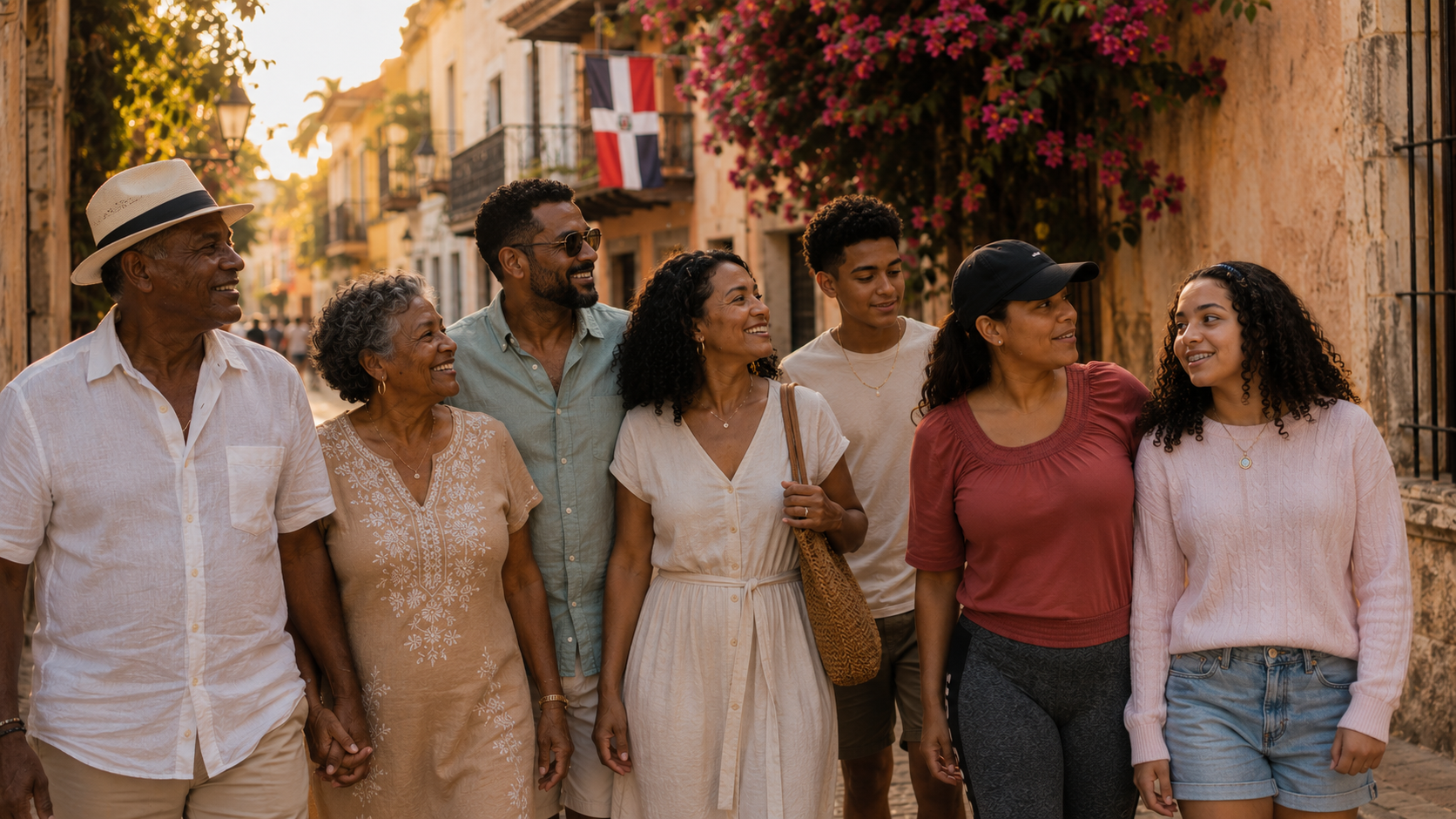
Your first visit to the Dominican Republic won’t stay inside a living room for long. Sooner or later, somebody is going to ask, “Have you seen the Zona yet?” They’re not talking about a shopping center or a neighborhood in the modern sense. They’re talking about Zona Colonial, the historic heart of Santo Domingo, and even if history isn’t normally your thing, don’t say no.
This isn’t the kind of place where you spend an afternoon reading plaques and pretending to be interested. It’s where Dominican history, family life, restaurants, music, and everyday city living all happen in the same few blocks. One minute you’re standing in front of a building more than five hundred years old, and the next you’re eating ice cream while a street musician plays and kids chase pigeons across Parque Colón. That’s what makes the Zona special. It isn’t frozen in time. People still live here.
Why Everyone Wants to Take You
If you’re visiting family in Santo Domingo, the Zona is one of the easiest places for everyone to enjoy together, which is exactly why it keeps getting proposed. The grandparents appreciate the history, the teenagers find dessert or somewhere to shop, the kids have plazas to run across, somebody inevitably wants coffee, and somebody else wants empanadas. Before long the afternoon stops being about sightseeing at all and becomes about spending time together in a beautiful place. That’s the version of the Dominican Republic you’ll actually remember.
Think about what you do when someone visits you. If you live near San Francisco, you take them to the Golden Gate Bridge, not because you need to see it again, but because sharing it is the point. The Zona is that place for Santo Domingo. When your family takes you, they’re not playing tour guide. They’re showing you something that belongs to them.
You’re Walking Through the Beginning of the Americas
Without turning this into a homework assignment, it helps to know why these blocks matter. After Columbus reached Hispaniola, Santo Domingo became the first permanent European city in the Americas. The first cathedral, the first hospital, the first university on this side of the ocean, all of it started here, and the street grid itself became the model that later Spanish colonial cities copied. UNESCO recognizes the Colonial City as a World Heritage Site for exactly that reason.
The amazing part is that none of it sits behind glass. You’re not visiting the museum. You’re walking through it, and there’s probably a motorcycle parked in front of it.
Don’t Try to See Everything
The classic first-timer mistake is treating the Zona like a checklist, rushing from landmark to landmark with a list to finish. The best moments here happen between the attractions: stopping for fresh juice, catching a wedding leaving the cathedral, finding a quiet courtyard, wandering into an art gallery you never planned to enter. The Zona rewards curiosity far more than planning, so build in time to be pulled off course.
That said, a handful of places earn their reputation. Parque Colón is the neighborhood’s living room, ringed by cafés and filled with families and musicians all day. The Catedral Primada de América, the first cathedral in the Americas, anchors the district. The Alcázar de Colón, built for Diego Columbus, shows you how the earliest colonial power actually lived, and the Fortaleza Ozama reminds you this was once a fortified city guarding Spain’s foothold in the New World. Connecting much of it is Calle El Conde, the pedestrian street where the shopping, snacking, and people-watching take care of themselves.
If you want the stories behind the stones rather than just the stones, this is the one place in Santo Domingo where a guided walking tour genuinely earns its price, especially on a day when the family historian isn’t available.
Two Pieces of Practical Advice
First, wear real shoes. This sounds like small advice until hour three. The streets are stone, beautiful and unapologetically uneven, and flip-flops belong at Boca Chica, not here.
Second, go hungry. If your family is showing you around, someone already has a favorite restaurant, and you should trust them completely. The Zona has become one of the best places to eat in the capital, from side-street cafés to dinner overlooking Plaza España. Don’t be surprised when lunch turns into coffee and coffee somehow becomes dinner. Days here have a way of unfolding like that.
When to Go
Morning is cooler and quieter, but late afternoon is the move. The heat eases, locals arrive, musicians appear, and the neighborhood slowly changes character. After sunset the old stone glows under warm lights, the restaurants fill with conversation, and the whole district feels alive without feeling rushed. It’s a different place than it was at noon, and you’ll want to see both versions.
The Part You’ll Remember
If Boca Chica shows you how Dominicans relax, the Zona Colonial shows you where their story began. Go because your family wants to show it to you. Go because your spouse has known these streets since childhood. The history is impressive and the architecture is beautiful, but years from now, what you’ll remember won’t be which building came first. It will be wandering those old streets with people who were excited to share a piece of their country with you.