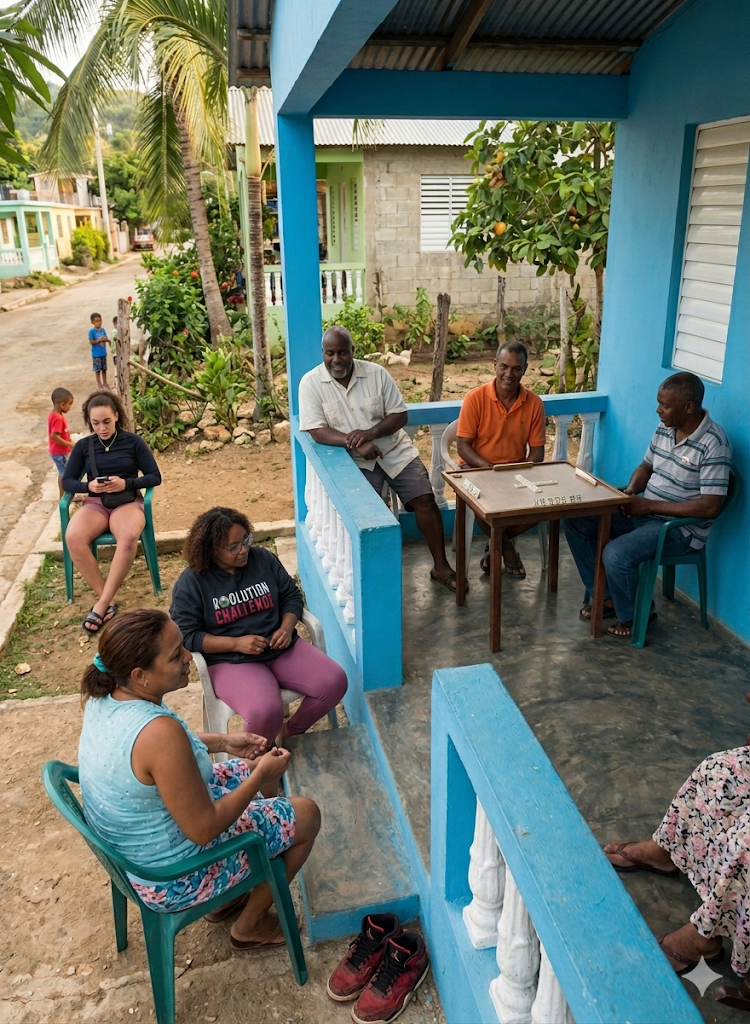
When You Visit Family in the DR, You’re Visiting the Neighborhood Too
When most people think about visiting family in another country, they picture the relatives — the aunts, the cousins, the grandmother who hasn’t seen you in years. What they don’t expect is that the family is the small part of the story.
In the Dominican Republic, especially in towns like Yamasá, family doesn’t exist in a vacuum. It exists inside something larger — a neighborhood, a street, a porch, a web of neighbors who have known each other long enough that the boundaries between households are more suggestion than rule. When you visit family here, you walk into all of that.
That’s worth understanding before you land.
The Invisible Infrastructure
There’s a woman who traveled from the DR to spend four months helping care for a new baby. She was living with family the entire time. She had a purpose. By any reasonable measure, she wasn’t alone. But she was miserable.
Not because the family failed her. Because what she had back home wasn’t something you can pack and bring with you. In Yamasá, life happened outside and in the open — neighbors on porches through the heat of the afternoon, someone always at the colmado, the neighborhood corner store that never really closes, children moving between houses without anyone keeping score. Here, the street was quiet, the doors were closed, and there was no ambient human presence to fill the hours between visits.
She was surrounded by the people she loved most. And she still missed the community. Not because it replaced family, but because family in the DR has always lived inside it.
You don’t notice the floor until it’s gone.
That same gap shows up in reverse. A young mother from the DR raises a baby in the United States and finds herself more exhausted than she expected. It isn’t the baby. It’s the absence of something she didn’t know she was counting on. Neighbors who’d take the child for an hour without being asked, grandmothers who’d step in automatically, the informal rotation of hands that means no one person carries the full weight alone. In the DR, that infrastructure exists. In a suburban American neighborhood, it usually doesn’t.
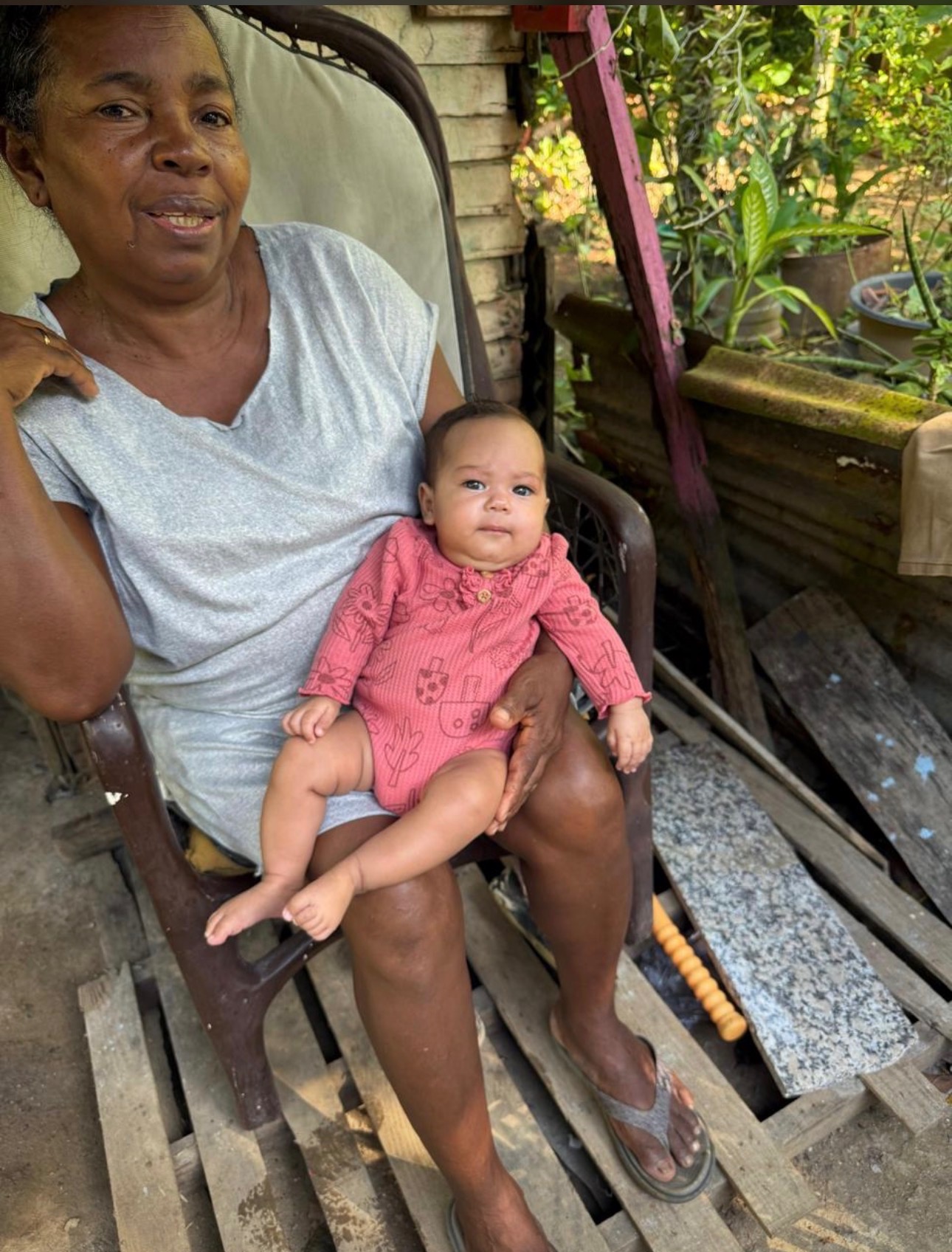
Community in motion — someone works, others are present. Nobody had to assign the roles.
How the Logic Works
There’s a cultural riddle that makes this concrete. Imagine four people standing on a crowded bus: an elderly woman, a pregnant woman, a mother carrying a baby, and a man on crutches with a broken leg. One seat opens up. Who gets it?
Most people answer quickly: the elderly woman.
But a Dominican answer adds a second layer that most outsiders don’t see coming.
The elderly woman gets the seat.
And she holds the baby.
Nobody assigned those roles. Nobody negotiated. The situation was read, the resources were redistributed, and two problems were solved with one chair.
That’s not unusual in Dominican communities — it’s instinctive. Caregiving isn’t a task assigned to one person. It’s something the group manages together based on who needs relief and who can offer it.
For a first-time visitor raised in a culture where personal space and individual responsibility are the defaults, this will catch you off guard. Not in a bad way. Just in a way you won’t expect. If you’re traveling with kids, pay attention to this — your children will adapt faster than you will.
What This Place Actually Is
None of this is meant to paint the Dominican Republic as a place where everything is warm and nothing is complicated. It isn’t. Poverty is real. Crime exists. Life here carries pressures that aren’t visible from the outside and aren’t softened by community bonds alone.
But there is a kind of wealth here that doesn’t show up in any economic index. The wealth of ambient human presence, of a neighborhood that functions like an extended family, of a social network built out of actual people rather than apps.
When you visit family in the DR, especially in towns away from the resort corridors, you’re entering that network. The porch isn’t decoration. The neighbor who stops to hold the baby isn’t overstepping. The street noise at ten in the evening isn’t a nuisance. These are all part of the same system. A place designed, whether intentionally or not, for people to live close to each other and share the weight of daily life.
You may find it overwhelming at first. Most people from privacy-centered cultures do. If you want to understand what the arrival actually feels like before you land, the SDQ arrival guide walks through the practical side — and the stories we wrote for young travelers carry some of this feeling too.
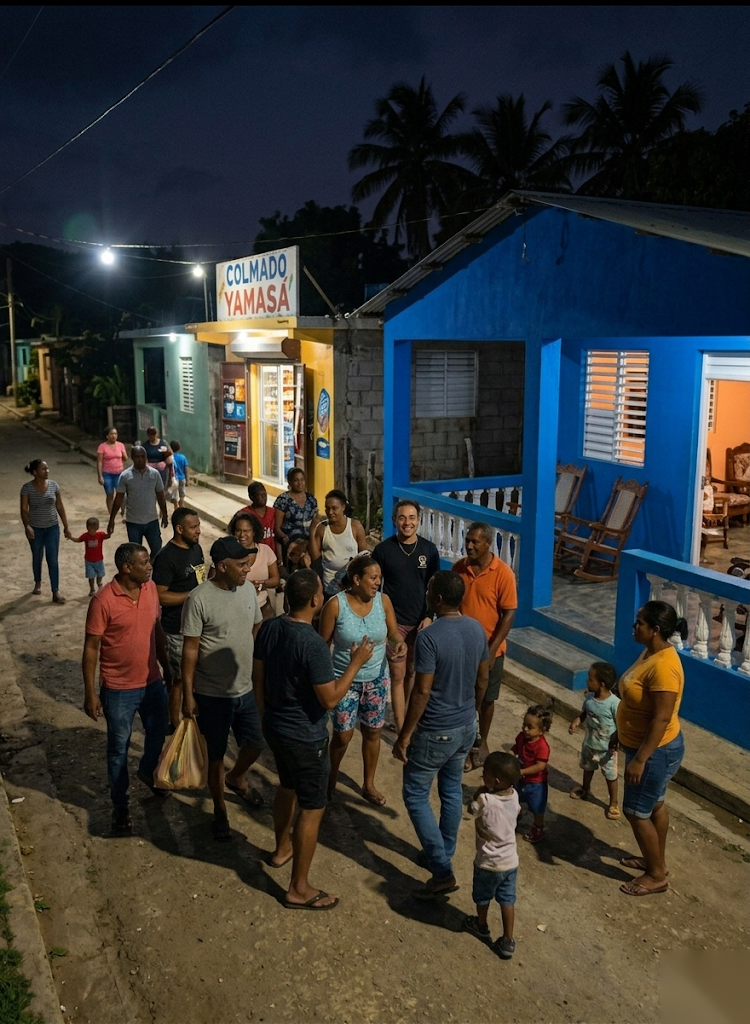
The colmado after dark. The street doesn’t empty — it just shifts.
Give it a day or two. Then notice how light it feels.
Before you land, make sure the practical side is covered — start here.