Dominican Republic Minor Travel Authorization (PSM): What Families Need to Know
If you’re reading this, someone probably mentioned a document you’ve never heard of right before a flight, or you’re the kind of planner who checks these things early. Either way is fine. This page walks through the Permiso de Salida de Menor, known as the PSM, the one document that can catch families off guard on the way home from the Dominican Republic.
The short version: this only applies to the trip leaving the DR, and only to certain children. Most visiting families never need it. But if it does apply to yours, it takes real lead time to get, so the earlier you know, the better.
Who Actually Needs This
The PSM applies to a minor who is a Dominican citizen, or who holds legal Dominican residency, and who is leaving the country without both parents. That covers a single parent traveling with the child, a grandparent or other relative doing the traveling, or a child flying with a third party or an airline’s unaccompanied minor program.
You’re very likely exempt if any of these describe your situation: both parents are traveling together, or your child is a foreign national visiting for under six months with no Dominican nationality or residency. Dual-national children who’ve been in the country less than six months since their last entry are also generally exempt — though they should still travel with a passport, birth certificate, and visa if one is required.
If you’re not sure which category your child falls into, that uncertainty is reason enough to check directly with Dominican migration before you book anything, rather than guess.
What You’ll Need
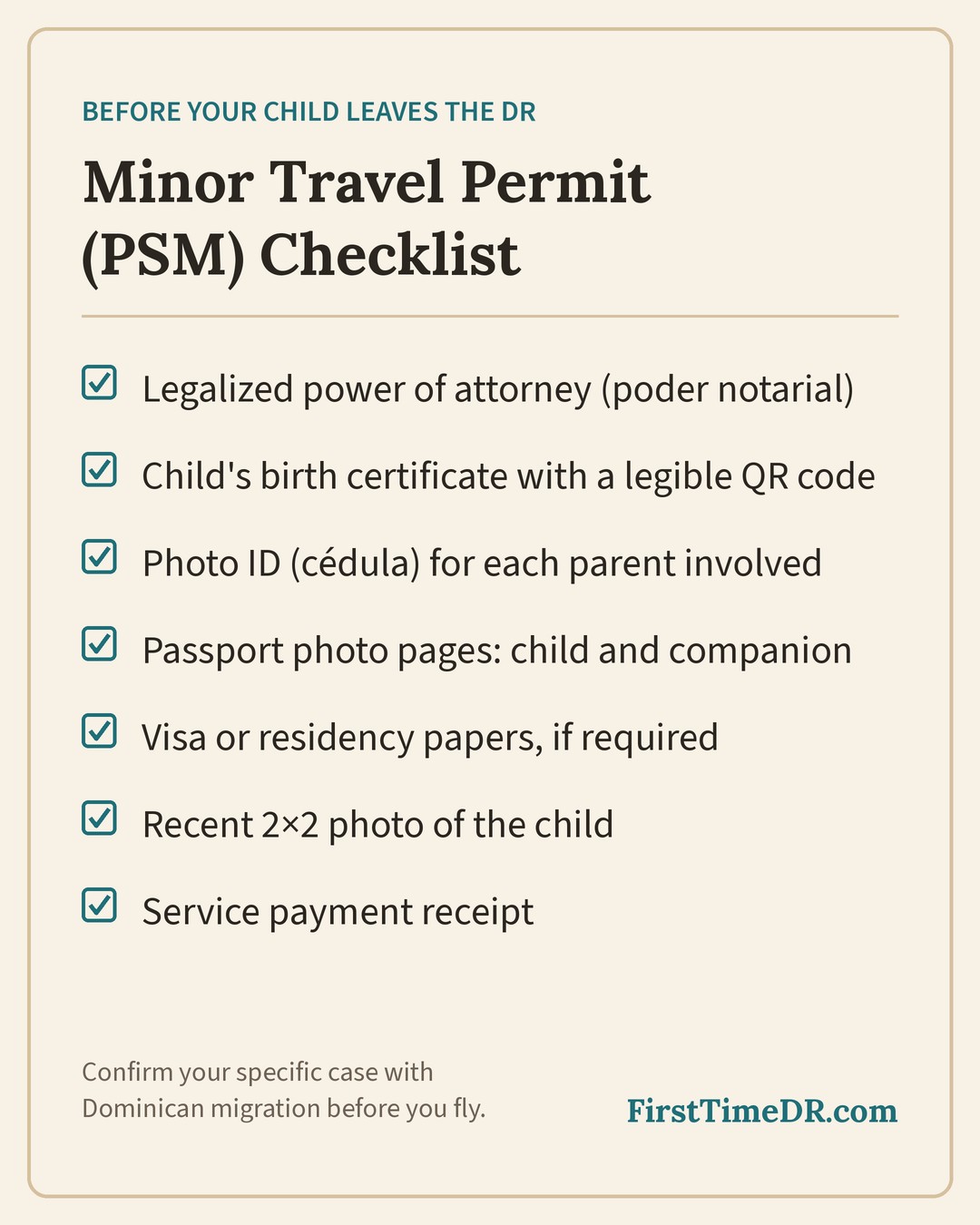
The core document is a power of attorney (poder notarial) authorizing the child’s exit with the traveling companion, signed by the parent(s) who aren’t traveling. It has to be legalized through the Dominican Attorney General’s Office (Procuraduría General de la República) or at a PuntoGOB Sambil location. Alongside it, standard requirements include:
- The child’s birth certificate with a legible QR code
- ID (cédula) of the parent or guardian making the request, and of the other authorizing parent
- Passport photo page of both the child and the traveling companion
- Visa or residency document for the child and companion, if the destination requires one
- A recent 2×2 photo of the child
- The service payment receipt
A few situations carry their own paperwork. If a court has granted sole custody, that ruling typically needs to accompany the permit request.
If a parent has passed away, the surviving parent traveling directly with the child doesn’t need to request a separate advance permit, but does need to carry the original, legalized death certificate (apostilled and translated if the death happened outside the DR) to present at departure. If the child is traveling with anyone other than the surviving parent, the surviving parent still has to provide notarized authorization through the standard process. Either way, this situation isn’t covered by the digital portal — it was never in scope for it, since that portal is built specifically for two living parents mutually authorizing each other — and still goes through the traditional route.
If your family’s situation involves a legal guardian or anything else outside these common cases, don’t assume you know what’s required from a government website at 11pm before a flight — confirm directly with migration or a professional who handles this regularly.
How the Process Works
There are two paths, plus one document-legalization step that most families will hit regardless of which path they take.
Digital (Recommended)
Currently in public beta, and built for the most common case — one parent authorizing the other to travel with the child. Start at the official digital PSM portal. The traveling parent creates the request; the other parent logs into their own account to authorize it. It handles notarization and legalization online, with the permit tied electronically to the child’s passport instead of printed — no in-person visit required. Budget up to 24 hours for the notarization and authorization step to clear (the portal’s own estimate, within Monday–Friday business hours — weekends and holidays don’t count toward it). It doesn’t cover every case — grandparents, guardians, and other arrangements still go through the traditional process — and it costs more than the standard single-child fee.
Traditional
Go through the Dominican migration services portal. Create an account, select the minor permit service, and upload scanned copies of your documents in JPG format. If anything’s missing, you’ll hear back by email with what still needs to be added. Once the file is complete, you’ll get a notification to pay the fee, either online or at a Banreservas branch. About 24 business hours after you submit, you bring the original documents to a migration office; the permit itself is typically ready within 48 business hours of that in-person visit, for pickup and printing.
There’s also a multiple-use option for families who expect to travel more than once with the same companion: it covers unlimited exits over one year, for a higher flat fee.
Don’t skip the legalization step. Both paths ultimately require the power of attorney to be legalized — it’s what makes the document valid. For the traditional path, that happens through the Procuraduría General de la República’s document-legalization service (RD$700, about 10 minutes once you’re in front of someone) or in person at Punto GOB Sambil in Santo Domingo (Av. John F. Kennedy, Esquina Paseo los Aviadores). The digital path handles this part online automatically, which is a real part of why it’s faster.
Fees and Timing
| Item | Cost / Time |
|---|---|
| Standard permit, first child | RD$2,000 |
| Each additional sibling, same application | RD$1,500 |
| Multiple-use permit (1 year, unlimited exits) | RD$10,000 per child |
| Digital one-parent-authorizes-other service (beta) | RD$6,300 flat |
| Permit validity | 90 days from issue |
| Standard processing | ~24 business hours to in-person visit, then up to 48 more hours to issue |
| Office hours | Monday-Friday, 7:30am-3:30pm (extended to 6:00pm in high season) |
Before You Rely on Any of This
This process has changed meaningfully in the recent past — the digital option didn’t always exist, and the rules on who needs what continue to get refined case by case on the official portal. The cost of being wrong here is a missed flight, not a minor inconvenience. Treat this page as a starting point for understanding what’s involved, and confirm your specific case directly before you travel.
If your child doesn’t need any of this, good news — head back to the Traveling With Kids guide → for everything else worth knowing before you fly.